The Big Sleep
I've spent the last year taking sleep seriously. Not obsessively. Not perfectly. Just deliberately. It's had a huge impact.
6 min read
I've spent the last year taking sleep seriously.
Not obsessively. Not perfectly. Just deliberately.
It's had a huge impact. I've seen a roughly 48% increase in restorative sleep, without spending more time in bed.
The single biggest change I made? I go to bed at roughly the same time every night.
I don't chase wake-up times. That takes care of itself when bedtime is stable.
“You really feel the difference in stamina and strength after a few sessions. There's a real sense of community and it's become my second home.”
— Rachna, Gymnasium Ealing
Why it matters
When you sleep well, your brain clears waste, locks in learning, sharpens decision-making and steadies your mood. Your body repairs tissue, regulates hormones, supports immunity and recovers properly.
When sleep is poor, all of that degrades quietly in the background, and is linked to a higher risk of cardiometabolic disease, cancer and early mortality. It's the biggest longevity lever most of us ignore, which is exactly why sleep sits at the base of the whole pyramid, not somewhere near the top with the supplements.
What surprised me most wasn't that sleep improved. It was how little I had to do to get there.
Go to bed at the same time every night.
What I changed, and in what order
There were other things too, but only after I'd nailed consistency:
- Bedroom cold (window open, fan), dark (eye mask) and quiet (ear plugs)
- Occasional hot shower before bed
- No caffeine after lunch
- No alcohol, bar the odd big night out
- More balanced training: less high intensity, more Zone 2 when recovery was low
- Magnesium and creatine
- Phone out of bed, red-light filter on
Notice the order. Bedtime consistency did most of the work on its own. Everything else was a smaller, later adjustment on top of a habit that was already holding. If you read our piece on why recovery isn't a product, this is that argument, but as the actual data from one very tired CEO.
"Same life. Same training. Same workload. Better sleep quality. Less drag. Better recovery."
“Every single class has challenged me mentally and physically but never leaving me feeling like I'm not capable.”
— Yvette, Gymnasium Ealing
The results
Six months at a time, tracked and compared.
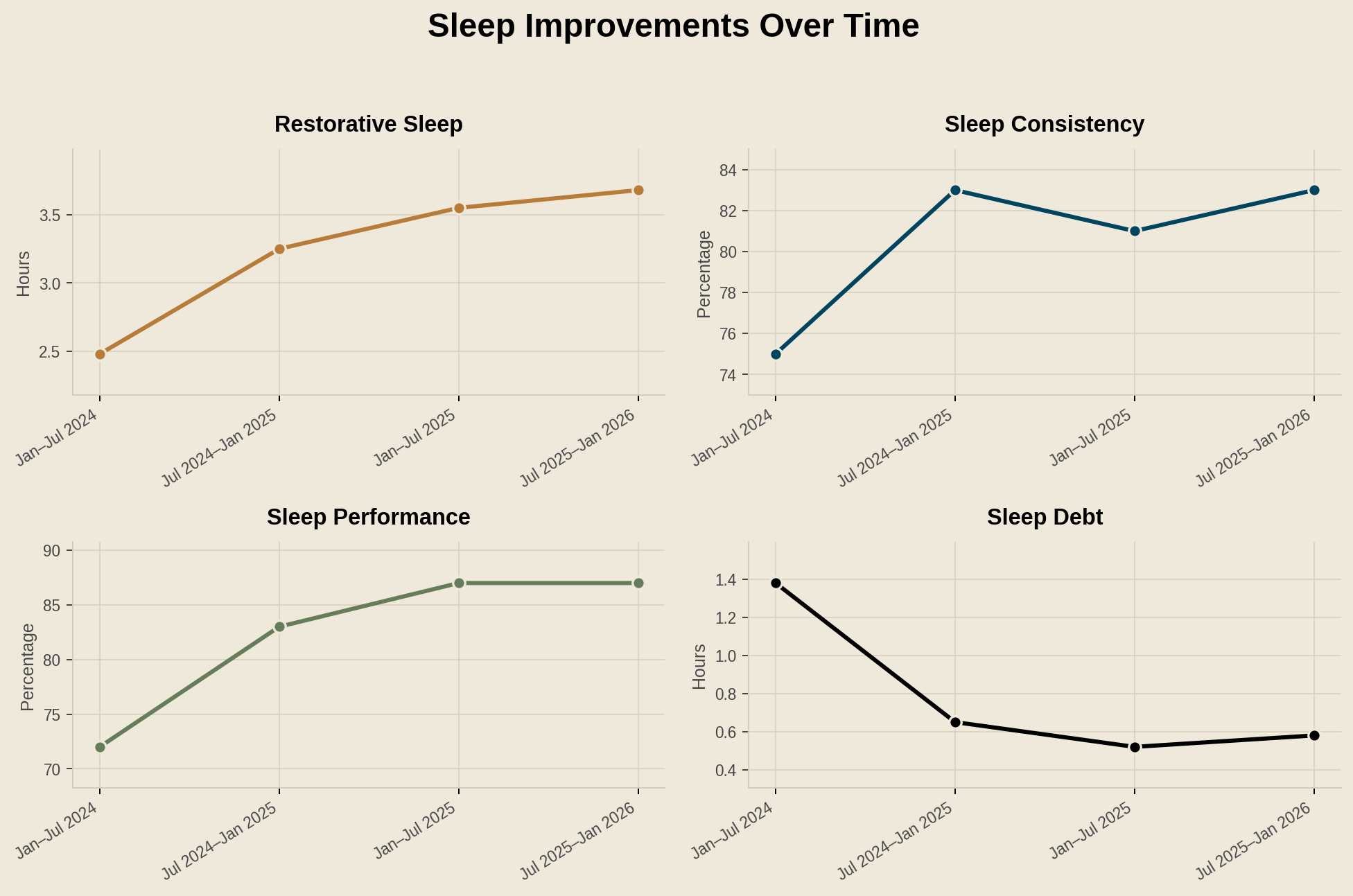
Same life. Same training. Same workload.
Better sleep quality. Less drag. Better recovery.
“The coaches are all excellent - they manage to help me progress and surprise myself constantly.”
— Marieke, Gymnasium Kennington
Sleep on purpose
None of this required a sleep clinic, a new mattress or a device strapped to my arm telling me things I already suspected. It required picking one behaviour and holding it for long enough to see what happened.
That's the whole method, and it's the same one we coach members through in The Big Sleep Project, our six-week programme built on exactly this order of operations: one habit, held properly, before adding the next.
Sleep on purpose. Everything else gets easier from there.